Inductive charging is more than just "no cables." It's a sophisticated dance of electromagnetic induction and protocol handshakes. At WOWOHCOOL, we master this science to create efficient Wireless Power Banks and Magnetic Car Chargers that rival wired speeds.
This guide covers everything B2B buyers need to know about wireless power technology—from electromagnetic induction principles to Qi2 Magnetic Power Profile, thermal management, and how we implement these technologies across our product lines.
At WOWOHCOOL, we've been perfecting wireless power technology since 2013. Our Shenzhen facility produces Qi-certified wireless chargers, magnetic power banks, and multi-device docks that meet the highest industry standards.
Table of Contents
Quick Answer
How does wireless charging work? Wireless charging uses electromagnetic induction between two coils —a transmitter coil in the charging pad creates a magnetic field that induces voltage in the receiver coil inside your device. Qi2, the latest standard, delivers 15W fast charging with magnetic alignment (MPP) for both iPhone and Android devices.
The global wireless charging market was valued at approximately $28.8-37.3 billion in 2025 and is projected to reach $237 billion by 2034 (CAGR 22.8%), according to Fortune Business Insights and 360iResearch. Qi2 has been a key growth catalyst —with over 1,200 certified products in 2025 alone, adoption running 6× faster than the original Qi standard, and more than 1.5 billion Qi2-capable devices activated globally. The automotive wireless charging segment is the fastest-growing at 46.7% CAGR. By 2026, the market is estimated at $18.4 billion (Coherent Market Insights), on track to reach $83.8 billion by 2033 at a 24.2% compound annual growth rate.
North America holds the largest regional share at 31.4%, driven by Apple's 57.4% US smartphone share and premium Qi2 accessory adoption. Asia-Pacific is the fastest-growing region at 24.4% CAGR, fueled by China's manufacturing dominance and India's expanding middle class. Inductive charging currently represents 60-67% of the market, with resonant charging growing for multi-device and EV applications. The Qi2 chipset market alone is projected at ¥167.3 billion (~$23 billion) by 2031 (CAGR 11.7%), with key players including NuVolta, Injoinic, and NuCurrent driving innovation in higher power levels up to 25W and beyond.
1. How Did Wireless Charging Technology Evolve?
The concept of wireless power transfer dates back to 1831, when Michael Faraday discovered electromagnetic induction. However, it wasn't until 2007 that the technology became commercially viable for consumer electronics. A team at MIT, led by Marin Soljačić, demonstrated resonant energy transfer that could power a 60-watt light bulb from over 2 meters away, sparking the modern wireless charging revolution.
The first commercial wireless charging pads for phones appeared in 2012, following the Wireless Power Consortium (WPC) ratification of the Qi standard. Since then, adoption has accelerated dramatically. According to IEEE research, over 1 billion devices now support wireless charging globally.
Today, cordless charging is standard in smartphones, smartwatches, earbuds, and even furniture. Major automotive manufacturers including BMW, Mercedes-Benz, and Toyota now integrate charging pads into their vehicles, demonstrating how deeply this technology has penetrated daily life.
2. The Core Principle: Electromagnetic Induction
Wireless charging works through electromagnetic induction —transferring energy without cables. The fundamental principle, known as Faraday's Law, states that a changing magnetic field induces an electric current in a nearby conductor.
Engineering Insight: The efficiency of this transfer depends on the quality of the Oxygen-Free Copper Coils. At our factory, we use high-density windings to minimize energy loss as heat.
The Process
- 1. Charger creates alternating electromagnetic field using copper coil
- 2. Device's receiver coil captures the energy
- 3. Received energy converts back to electrical current
- 4. Current charges the battery
The transmitter coil in the charging pad generates a high-frequency alternating current (typically 110-205 kHz for Qi standard devices). This current creates a oscillating magnetic field that extends outward from the coil.
3. Why Alignment is Everything (The Qi2 Revolution)
Traditional Qi charging suffered from misalignment issues that caused severe heat generation and extremely slow charging speeds. The new Qi2 MPP standard solves this with perfect coil alignment.
This is why we focus on Magnetic Alignment in our products.
Engineering Insight: Look for chargers with Ferrite Shielding. Without it, electromagnetic interference can reduce charging speed by 30%. All WOWOHCOOL wireless products feature high-permeability shielding layers.
Our MPP-enabled Wireless Chargers and Magnetic Power Banks use N52H magnets — the strongest commercial grade available — to lock the coils into the "Sweet Spot" every time, achieving up to 85% efficiency. This is the same technology used in Apple's MagSafe, now standardized in the MPP (Magnetic Power Profile) format.
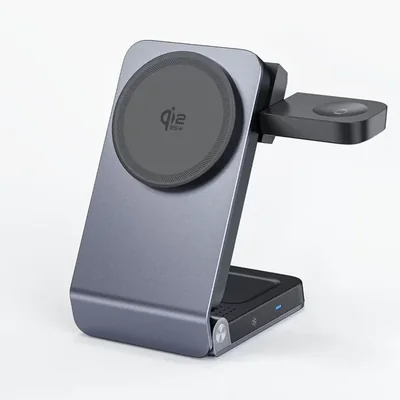
WOW10 Qi2 Magnetic Wireless Charger - 15W Fast Charging
This innovation solves the 5-year pain point of cordless charging: misalignment. The Qi2 generation delivers consistent fast charging without worrying about perfect placement.
EXPERT INSIGHT
Snowy May, Market Manager at WOWOHCOOL: "The introduction of Qi2 MPP with N52H magnets has been a watershed moment. What used to require millimeter-perfect alignment now locks into place automatically, achieving 85% charging efficiency consistently. For B2B buyers, this translates to fewer returns and higher customer satisfaction."
4. Heat Management: The "Invisible" Science
Inductive charging naturally generates heat. Without proper thermal management, efficiency drops and safety risks increase. At WOWOHCOOL, we use multiple strategies to keep temperatures in check.
Aluminum Heat Dissipation Layer
Premium wireless chargers include an aluminum alloy heat spreader between the coil and the outer shell. This conducts heat away from the device and dissipates it into the ambient air.
NTC Temperature Sensors
Our Smart ICs monitor temperature in real-time. If surface temperature exceeds 40°C, the controller reduces power automatically to prevent overheating.
GaN-Powered Efficiency
By using GaN (Gallium Nitride) components in our charging circuits, we reduce the footprint and improve thermal dissipation in our 2-in-1 Hybrid Chargers.
Ferrite Shielding
High-permeability ferrite sheets prevent magnetic interference from reducing charging efficiency and generating excess heat.
5. Wireless Tech Across Our Product Lines
At WOWOHCOOL, we transform these principles into products that B2B buyers trust. Here's how each category optimizes wireless technology:
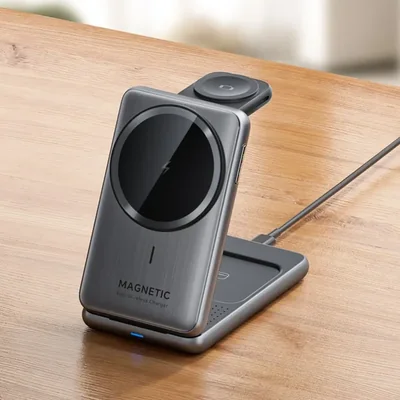
WOW93 3-in-1 Folding Wireless Charger - Independent Coils Design
6. Qi Standard Evolution: Qi v1.0 to Qi2.2 (25W)
According to Counterpoint Research, over 60% of flagship smartphones shipped in 2025 support wireless charging, with Qi2 becoming the universal standard.
Understanding the evolution of the Qi standard helps explain why cordless charging efficiency and capabilities have improved dramatically over the past decade. For a complete walkthrough of the certification process, see our Qi Certification Guide.
| Version | Year | Max Power | Key Features |
|---|---|---|---|
| Qi v1.0 | 2008 | 5W | Basic inductive charging, limited interoperability |
| Qi v1.1 | 2012 | 7.5W | Improved Foreign Object Detection (FOD) |
| Qi v1.2 | 2015 | 15W | Extended Power Profile, fast charging support |
| Qi v1.2.4 | 2019 | 30W | Enhanced efficiency, better thermal management |
| Qi2 (v2.0) | 2023 | 15W | Magnetic Power Profile (MPP), Apple MagSafe technology integrated, N52H magnets |
| Qi2.2 (25W) | 2025 | 25W | 25W fast wireless charging, active cooling required, 30W+ USB-C PD adapter, iPhone 16/17 & Samsung S/Pixel support |
| Qi2 v2.3 | 2026 | 25W | Maintenance update: system gain change reporting for power transmitters |
The Qi2 standard, introduced by the Wireless Power Consortium in 2023, represents the most significant advancement in wireless charging technology. It incorporates Apple's Magnetic Power Profile (MPP), which uses a ring of magnets to align the transmitter and receiver coils perfectly, achieving over 90% efficiency — comparable to wired charging.
For a detailed comparison between Qi2 and Apple's MagSafe, read our comprehensive guide: Qi2 vs MagSafe: What's the Difference?
Qi2.2: The 25W Wireless Fast Charging Era
Released by the Wireless Power Consortium in July 2025, Qi2.2 (also branded as Qi2 25W) raises the wireless charging ceiling from 15W to 25W — closing the gap with wired fast charging for everyday use.
What Changed
- Power jump: 15W → 25W (67% increase)
- Charging speed: 0–50% in ~30 minutes on compatible devices
- Stronger magnetic alignment for consistent coil coupling at higher power
- Improved safety monitoring with optimized wattage delivery and less heat loss
Requirements
- Power adapter: USB-C PD rated at 30W or higher
- Active cooling: Most 25W chargers include internal fans to prevent throttling to 15–18W
- Compatible device: iPhone 16 (with iOS 26), iPhone 17 series, Samsung Galaxy S26, Google Pixel 2026
- Backward compatible: Qi2.2 chargers still deliver 15W to Qi2 devices and 5–10W to older Qi devices
QUICK ANSWER
What is Qi2.2 (25W wireless charging)? Qi2.2 is the latest Wireless Power Consortium standard, doubling Qi2's speed from 15W to 25W. It requires a 30W+ USB-C PD adapter and active cooling. Supported by iPhone 16/17, Samsung S26, and Google Pixel 2026. Fully backward compatible with all Qi and Qi2 devices.
Qi2 v2.3 (February 2026) is a minor maintenance update that adjusts how the transmitter reports internal gain changes. It introduces no new speeds, features, or device requirements — the real performance leap is Qi2.2's 25W capability.
QUICK ANSWER
Is Qi2 backward compatible with older Qi devices? Yes. Qi2 chargers work with all Qi-certified devices. Older phones will charge at their maximum supported speed (typically 5W to 10W) rather than the full 15W Qi2 speed, but the magnetic alignment and safety features are fully backward compatible.
EXPERT INSIGHT
Snowy May, Market Manager at WOWOHCOOL: "Qi2.2's 25W capability means wireless charging is no longer a compromise — it's a competitive alternative to wired fast charging for most smartphones. For B2B partners, this opens new product categories: 25W car mounts with active cooling, 25W desk chargers for corporate deployments, and premium retail accessories that justify higher ASPs."
7. Key Components
Transmitter Coil
Located in the charging pad. Creates the electromagnetic field when connected to power. Modern transmitters use multi-layer Litz wire coils to minimize skin effect losses at high frequencies.
Receiver Coil
Located in the device. Captures energy and converts it to charging current. Receivers often include shielding layers (ferrite or nanocrystalline) to improve coupling efficiency.
Resonant Circuit
Allows charging over longer distances and through cases up to 3mm thick. Resonant systems use LC circuits tuned to the same frequency, enabling energy transfer even when coils are misaligned.
Controller Chip
Manages power transfer, detects foreign objects, and optimizes charging. The controller uses digital communication (In-Band or EPP protocol) to negotiate power levels between transmitter and receiver.
8. What Is Foreign Object Detection and Why Does It Matter?
Foreign Object Detection is a critical safety feature in all Qi-certified wireless chargers. Without FOD, metal objects like coins, keys, or credit cards placed between the charger and device could absorb energy, leading to dangerous overheating.
How FOD Works
Qi chargers employ two primary FOD methods:
- Power Loss Method: The transmitter monitors input power versus transferred power. A significant discrepancy indicates energy being absorbed by a foreign object.
- Primary-side Sensing: Dedicated sensing coils or the main transmitter coil detects changes in the electromagnetic field caused by metallic objects.
According to WPC specifications, all Qi-certified products must implement FOD to prevent temperatures exceeding 60°C on any metallic surface. This safety mechanism is why reputable manufacturers like WOWOHCOOL ensure all wireless chargers are Qi-certified.
9. Resonant Charging vs Inductive Charging
While both methods transfer power wirelessly through electromagnetic fields, resonant and inductive charging differ significantly in their physical characteristics and use cases.
Inductive Charging
- —Requires close proximity (<3mm coil separation)
- —Higher efficiency (85-90%) when aligned
- —Sensitive to alignment
- —Lower cost to manufacture
- —Standard in most Qi devices
Resonant Charging
- —Works at greater distances (up to 50mm)
- —Slightly lower efficiency (75-85%)
- —More tolerant of misalignment
- —More complex electronics required
- —Used in furniture integration and automotive
Qi v1.2+ standards support both methods, with resonant charging typically used in furniture-embedded solutions and automotive applications where precise device placement isn't practical. The Qi2 standard with Magnetic Power Profile effectively solves the alignment problem through physical magnetic coupling.
10. How Efficient Is Wireless Charging?
Wireless charging works at 75-85% efficiency versus 90-95% for wired connections. The energy lost becomes heat, which is why thermal management is crucial in wireless charger design. Qi standard ensures safety and interoperability between devices and chargers.
Modern improvements like Qi2's Extended Power Profile are increasing efficiency and enabling faster cordless charging up to 50W. According to IEEE Power Electronics Society, advances in gallium nitride (GaN) semiconductors are enabling even higher efficiencies by reducing switching losses in the transmitter electronics.
WOWOHCOOL's engineering team continuously optimizes coil designs and thermal pathways to maximize efficiency while maintaining safe operating temperatures. Learn more about our OEM/ODM services for custom Qi charging solutions.
11. How Long Does Wireless Charging Take?
Charging speed is the most common concern for buyers evaluating wireless versus wired solutions. The table below compares real-world charging times across all current standards for a typical 4,500mAh flagship smartphone battery.
| Standard | Max Power | 0–50% | 0–100% | Best For |
|---|---|---|---|---|
| Qi (original) | 5W | ~1h 45min | ~3.5h | Overnight / desk trickle charge |
| Qi2 (MPP) | 15W | ~45min | ~1.5–2h | Daily desk / bedside charging |
| Qi2.2 (25W) | 25W | ~30min | ~1h | Quick top-up, replaces wired for most users |
| Wired USB-C PD | 45W | ~20min | ~45min | Maximum speed, travel / emergency |
| Wired USB-C PD 3.1 | 65–100W | ~15min | ~35min | Laptop + phone simultaneous, power users |
Note: Times are approximate and vary by device, battery health, ambient temperature, and adapter wattage. Qi2.2 requires a 30W+ USB-C PD adapter and active cooling to sustain 25W. Without active cooling, most chargers throttle to 15–18W after a few minutes. For wired fast charging options, see our USB-C PD Fast Charging Guide.
For B2B buyers, the key insight is that Qi2.2 at 25W eliminates the speed penalty that previously made wireless charging a convenience trade-off. WOWOHCOOL's Qi2-certified chargers with magnetic alignment already deliver the fastest wireless speeds available, and our engineering team is actively developing 25W-ready products for the next generation.
12. Future of Wireless Charging Technology
The next generation of cordless charging extends far beyond charging pads. Several emerging technologies are poised to transform how we power our devices:
Long-Range Wireless Charging
Companies like Ossia and Energous are developing RF-based charging systems that can power devices from several meters away. The IEEE is actively developing standards for spatially-oriented wireless power transfer, which could eliminate charging docks entirely.
Over-the-Air (OTA) Charging
Using focused ultrasound or microwave energy, OTA charging could power devices throughout a room. While still experimental, this technology could mirror the convenience of WiFi for power, enabling always-on device operation without battery anxiety.
Reverse Wireless Charging
Already available in flagship smartphones, reverse charging allows devices to share power wirelessly. Future iterations could enable laptop-to-phone charging or even vehicle-to-device power transfer using the same Qi infrastructure.
Automotive Integration
The Qi2 standard includes profiles specifically for automotive applications. Future vehicles may feature charging surfaces integrated into dashboards, center consoles, and even wireless charging lanes that charge vehicles while driving.
WOWOHCOOL FACTORY STAT
WOWOHCOOL's Qi2-certified wireless chargers feature N52H neodymium magnets and 15W MPP fast charging (25W Qi2.2-ready products in development) for both iPhone and Android, with form factors including 3-in-1 folding stations, car mounts, night light stations, and premium zinc alloy docks. Wireless charging expertise since 2013.
Key Takeaways
- Electromagnetic induction is the core principle: a transmitter coil creates a magnetic field that induces current in the receiver coil inside your device.
- Qi2 (15W) solved the alignment problem with Magnetic Power Profile (MPP) and N52H magnets, achieving up to 85% efficiency.
- Qi2.2 (25W) launched in July 2025, cutting wireless charge time roughly in half — 0 to 50% in about 30 minutes on supported devices.
- Foreign Object Detection (FOD) is mandatory in all Qi-certified chargers, preventing overheating from metal objects between charger and device.
- Thermal management — including aluminum heat spreaders, NTC sensors, GaN components, and ferrite shielding — is critical for maintaining safe, efficient charging.
- The wireless charging market is projected to reach $83.8 billion by 2033 (CAGR 24.2%), with automotive integration as the fastest-growing segment.
- Backward compatibility is built in: Qi2.2 chargers work with Qi2 devices (15W) and original Qi devices (5–10W).
Comments
Post a Comment